
Por Mag. Marisa Avogadro Thomé – Especial
Traducción al español de la autora de la entrevista
El mar Mediterráneo deja sus huellas en la playa, en la arena, en la esencia de las personas y en sus miradas. Una mirada que acompañaría al Ing. Ghazi Toutounji desde su Líbano natal, a Chipre y Canadá, para dejar plasmado en un lienzo que la nostalgia tiene formas, colores, y sentires. Su Mediterráneo, su gente, sus paisajes lo acompañan en la actualidad y se transforman en pinturas. Pinceladas de pigmentos y agua imitando el mar, los techos, las construcciones típicas del Líbano de ayer y de hoy.
Imaginando un barco fenicio que recorre las costas hasta llegar a América del Norte, comenzamos la travesía de esta entrevista.
- ¿Cuándo y cómo se dio cuenta de que quería ser artista?
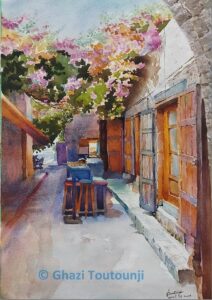
Desde muy pequeño tuve facilidad para el dibujo. Solía dibujar a todas las personas que me rodeaban. Una vez, en la escuela primaria, el maestro interrumpió la clase y me pidió que dibujara al compañero que estaba sentado a mi lado, en el mismo pupitre. Más adelante, ya inmerso en mi vida laboral, comencé a practicar la pintura y el dibujo con diversas técnicas en casa, durante mi tiempo libre. Me casé en 1988 y, poco después, me mudé a Chipre. Allí realicé algunas acuarelas que se expusieron en una galería de Nicosia, donde logré vender varias de ellas. Continué pintando tras emigrar a Canadá, donde realicé algunas exposiciones y vendí varias de mis obras, principalmente acuarelas. Sigo considerando la pintura como una afición.
- ¿De qué manera influye su formación técnica en ingeniería en tu proceso artístico sobre el lienzo?
Soy ingeniero mecánico, y mi formación en ingeniería ha influido en mi proceso artístico al llevarme a adoptar un enfoque realista, centrado en la precisión y en la representación exacta de la escena. Considero que esto limita el proceso creativo y la libertad de expresión, por lo que intento reducir su impacto tanto como me es posible.
- ¿Cuáles son sus principales fuentes de inspiración?
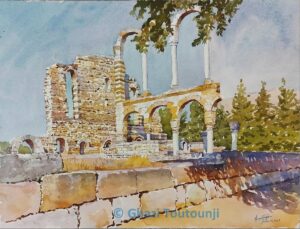
Mis fuentes de inspiración son variadas; provienen, en su mayoría, de fotografías, ya sean tomadas por mí o provenientes de otras fuentes. Me atraen especialmente las escenas que evocan belleza, nostalgia, juegos de luces y sombras, y emociones. En el pasado, durante mis primeros años, solía realizar muchos retratos del natural.
- La nostalgia parece ser un tema recurrente en su obra. ¿Cómo logra plasmar los recuerdos de los paisajes mediterráneos mientras vive en Canadá?
Como mencioné anteriormente, me baso en fotografías —propias o de otras fuentes— que me recuerdan al Líbano y a mis primeros años vividos allí.
. Uste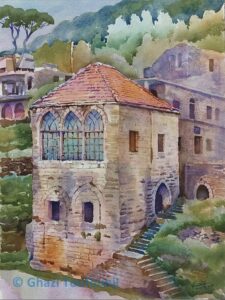 d trabaja con diversas técnicas, como la acuarela, el óleo y el pastel. ¿Cómo decide qué técnica se adapta mejor a un tema o estado de ánimo en particular?
Utilizo diferentes medios, pero en los últimos años me he centrado en la acuarela, debido a la sencillez de su preparación y a que requiere menos tiempo de ejecución. Intento adaptar mi enfoque a los distintos temas y estados de ánimo.
. ¿Hay artistas libaneses o canadienses en particular que hayan marcado de forma fundamental tu visión artística?
Observo el trabajo y los vídeos de muchos artistas, y aprendo de ellos. No hay un artista en concreto que haya definido mi visión o mi estilo artístico.
- ¿Tiene proyectos en marcha, nuevos medios o temas conceptuales que esté explorando o con los que planee experimentar?
Por el momento, no tengo proyectos ni ideas concretas en desarrollo. Durante el último año (o más), he reducido considerablemente mi actividad pictórica, principalmente debido a diversas circunstancias y compromisos familiares. Espero poder retomar el ritmo en el futuro. Todavía me queda mucho camino por recorrer para dominar mejor tanto la técnica como el proceso creativo. Con ese objetivo, intento experimentar con diversas técnicas e ideas.

By Mag. Marisa Avogadro Thomé – Special
- When and how did you first realize you wanted to become an artist?
I have had drawing skills since my very early childhood. I used to draw everybody around me. One time, in elementary school, the teacher stopped the class and asked me to draw the student sitting on the same bench beside me. Later on in life and after my entrance in the working world, I started practicing painting and drawing in various media at home in my free hours. I got married in 1988, and shortly after I moved to Cyprus, where I did a few watercolor paintings that were exhibited in a gallery in Nicosia, and a number of them were sold. I continued the painting process after immigrating to Canada and exhibited a few times, and sold a number of my paintings, mostly watercolors. I still consider painting a hobby.
- In what ways does your technical experience in engineering shape your artistic process on the canvas?
I am a mechanical engineer, and my engineering background influenced my artistic process in a way that I am a realist painter and focus on accuracy and exact depiction of the scene. I find this restricts the creative process and freedom of expression, and I try to limit its effect as much as I can.
- What are the primary sources of inspiration behind your paintings?
The primary sources of inspiration are various and mostly from photos, either taken by me or from other sources. I am mostly attracted to scenes that reflect beauty, nostalgia, light and shade, and feelings. In the past, I did a lot of live portraits since my early years.
- Nostalgia appears to be a recurrent theme in your work. How do you capture memories of Mediterranean landscapes while living in Canada?
As I mentioned above, I rely on photos that I took or other sources. Those photos remind me of Lebanon and my early years there.
- You work with multiple mediums, including watercolor, oil, and pastel. How do you decide which medium best suits a specific subject or mood?
I work in various media, but I have focused over the past few years on watercolor due to the ease of setup and short painting time. I try to make it work for the various subjects and moods.
- Are there specific Lebanese or Canadian artists who have fundamentally shaped your artistic vision?
I see a lot of artists’ work and videos, and I learn from them. There is no specific artist that shaped my artistic vision or style.
- Are there any upcoming projects, new mediums, or conceptual themes that you are currently exploring or planning to experiment with?
There are no upcoming projects or ideas at the moment. I have slowed down my painting process activity a lot over the last year or more, mostly due to circumstances and family commitments, and I will try to improve this in the future. I still have a long way to go to master more the technique and the creative process. I try to experiment with various techniques and ideas towards that goal.